

Sony A7 V Review – Specifications, Photography and Video Performance

Updated: Jul 30
In This Sony A7 V Review, We Examine the Camera’s Technical Specifications and Its Photography and Video Performance in Detail
Sony’s long-awaited Alpha 7 Mark V (A7 V) has finally been announced. Its 33-megapixel partially stacked Exmor RS full-frame sensor, new-generation BIONZ XR2 processor and advanced AI-assisted autofocus system introduce substantial improvements over the A7 IV. Sony is positioning the A7 V as a genuinely hybrid camera, balancing high resolution and speed for both photography and video rather than prioritising only one side of production.
The camera retains the 33 MP resolution inherited from the A7 IV, but the partially stacked sensor architecture increases readout speed by approximately 4.5 times and substantially reduces rolling-shutter distortion. Video upgrades include 7K-derived 4K 60p recording and 4K 120p slow motion in APS-C mode. In the sections below, we examine the A7 V in detail and compare it with the A7 IV, A7R V, A7S III and competing cameras in the same segment. The review covers sensor performance, video formats, ergonomics, autofocus, AI functions, battery life, storage, connectivity and accessory compatibility, alongside professional assessments and early user feedback.
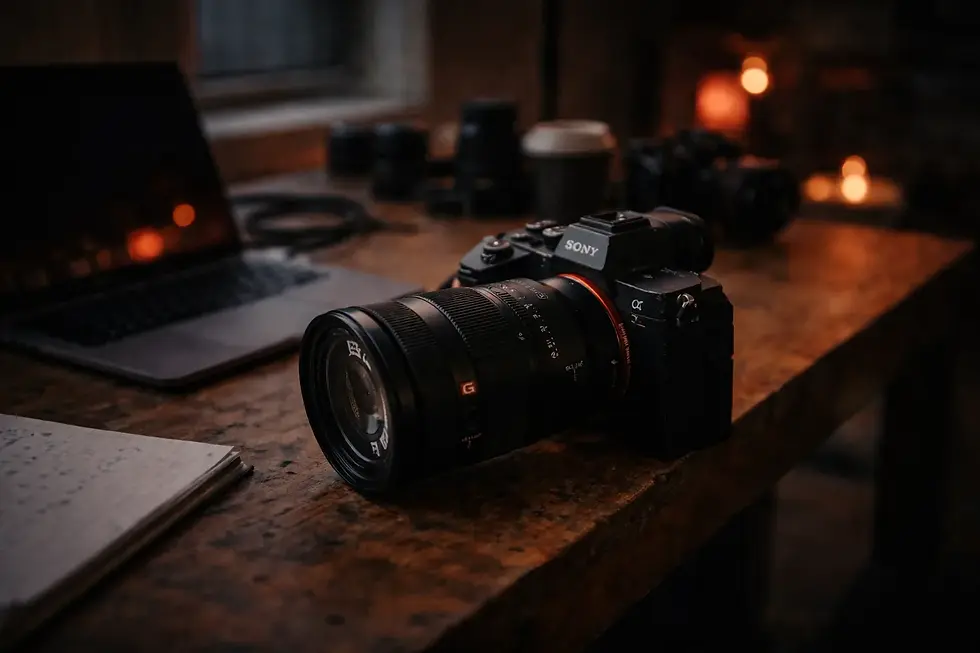
Sony A7 V Review: Sensor, Resolution and ISO Performance
Sensor and Resolution: The Sony A7 V uses a 33-megapixel, back-illuminated and partially stacked Exmor RS CMOS full-frame sensor. It is notable as Sony’s first partially stacked sensor in this class. The A7 IV also used a 33 MP BSI Exmor R sensor, but the A7 V integrates additional memory and processing circuitry into the sensor architecture, allowing data to be read much more quickly.
According to Sony, the A7 V’s sensor readout is approximately 4.5 times faster than the A7 IV. In practice, that makes the rolling-shutter or “jello” effect far less visible in moving scenes. Early measurements put rolling-shutter time at roughly 12 ms in the full-frame 7K readout used for 4K video, compared with approximately 67 ms on the A7 IV. This is a major improvement and allows the electronic shutter to be used in high-speed situations with far less visible distortion.
Although the nominal resolution remains the same, the new sensor architecture improves both speed and image quality. Sony claims more than 16 stops of dynamic range at low ISO, approximately one stop more than the A7 IV, together with lower shadow noise and improved signal processing. These changes make the A7 V attractive even for sport, action and wildlife photography, where a 33 MP file can now be captured at very high speed with cleaner subject rendering.
The sensor is partially stacked rather than fully stacked. Fully stacked sensors, such as those in the Sony A1 and A9 III, still offer the fastest readout and lowest distortion. The A7 V adopts a middle-ground solution that provides many of those benefits at a lower cost. The A9 III, for example, eliminates rolling-shutter distortion through global-shutter technology, but is limited to 24 MP and sits at a much higher price. The A7 V instead combines 33 MP resolution with a small amount of remaining rolling shutter and a far broader general-purpose role.
Its 33 MP resolution is lower than the A7R V’s 61 MP. Users who require extremely large prints or aggressive cropping may therefore still prefer the A7R V. On the other hand, the A7R V’s BSI sensor is not stacked and cannot match the A7 V in continuous shooting, where it is limited to around 10 fps. The A7 V therefore establishes a new balance between resolution and speed: it is neither as resolution-driven as the A7R line nor as purely speed-focused as the A9/A1 family.
ISO Sensitivity and Dynamic Range: The A7 V is specified at ISO 100–51,200 for stills, expandable to ISO 50–204,800, and ISO 100–51,200 for video, expandable to ISO 102,400. Those numbers are similar to the A7 IV on paper, but the new sensor and processor improve high-ISO noise performance. Sony also states that the camera retains 14-bit RAW output while using the electronic shutter.
This matters because the A7 IV could fall to 12-bit output in some electronic-shutter conditions. The faster readout of the A7 V allows continuous 14-bit RAW capture, including during burst shooting. Early reviews report less grain in shadow areas and cleaner colour transitions. Cameras such as the A7S III and FX3, whose 12 MP sensors use much larger pixels, still have an advantage at extreme sensitivities such as ISO 51,200 and above, but the A7 V remains very clean through approximately ISO 12,800 and is suitable for the majority of professional low-light work.
At ISO 25,600 the A7 V behaves broadly like the A7 IV, while fine detail loss and noise become more visible around ISO 51,200–102,400. Its low-light performance is therefore more than sufficient for general production, while the A7S III remains preferable only for environments with exceptionally little available light. The A7 V does not use a cinema-style dual-base-ISO system. In S-Log3, its base ISO remains 800, as it did on the A7 IV, rather than using the 640/12,800 structure associated with the A7S III.
Sony says the gain structure has been optimised to protect highlight and shadow information across the camera’s broad ISO range, with the cleanest output generally achieved between ISO 100 and 800. The AI-assisted Auto White Balance system can also recognise the type of light in the scene and select a more appropriate colour temperature. This is particularly useful in mixed-light environments, where conventional automatic white balance may shift inconsistently between sources.
Photography Performance: The A7 V combines high resolution and high speed in a way the A7 IV could not. The 33 MP files preserve fine detail for large prints and creative cropping, while the electronic shutter enables continuous shooting at up to 30 frames per second. This rate is available with active AF/AE tracking and a blackout-free viewfinder, so the live image remains visible while the camera records the burst.
Sony has also added Pre-Capture. When the shutter button is held halfway down, the camera begins buffering frames. When the button is fully pressed, it can save images from approximately 0.5–1 second before the decisive moment. This is highly practical for birds, sport and other unpredictable subjects where human reaction time would otherwise cause the key frame to be missed.
The faster electronic shutter moves the A7 V closer to Sony’s A9 series. The A9 II delivered 20 fps at 24 MP; the A7 V reaches 30 fps at 33 MP. The A7 IV was limited to 10 fps at the same resolution. A mechanical shutter remains available and supports 10 fps continuous shooting with shutter speeds up to 1/8000 second. The electronic shutter can reach 1/16,000 second, which is useful when shooting with a wide aperture under very bright light.
Another addition is a set of multi-frame high-resolution and noise-reduction options. Composite RAW Shooting combines 4, 8, 16 or 32 RAW frames in Sony Imaging Edge Desktop to reduce noise and extend dynamic range. This is mainly intended for tripod-based work and static subjects. Extended RAW uses an AI algorithm to generate a 132 MP super-resolution RAW file from a single 33 MP frame, offering a software-based alternative to conventional pixel-shift methods for subjects that may not remain perfectly still.
For example, a wildlife photographer can enlarge a 33 MP telephoto frame to an AI-assisted 132 MP file while retaining more usable detail. These modes require post-production software and an additional processing step, but they bring resolution and noise-management tools that previously belonged to more specialised bodies into the general A7 range.
Overall, the A7 V represents a substantial photographic improvement over the previous generation. Resolution has not changed, but 30 fps bursts, pre-capture, improved dynamic range, cleaner shadows and much lower rolling shutter completely change what can be achieved with those 33 megapixels. The A7R V remains the stronger choice for maximum detail, and the A7S III remains stronger at the most extreme ISO values, but the A7 V covers a much wider range of professional assignments in one body.
The camera’s 30 fps rate is not limited to JPEG. Compressed RAW can also be used, and Sony states that autofocus and exposure calculations continue throughout the burst. The practical burst length varies with file type and card speed, so maximum performance requires CFexpress Type A. With slower media, the camera still reaches the stated frame rate but the buffer takes longer to clear after a sustained sequence.
Electronic-shutter shooting also retains a broad set of exposure options. The reduced readout time lowers banding risk under artificial lighting, although users should still match shutter speed to the frequency of LED or fluorescent sources. Anti-flicker functions remain available for stills, and the fast sensor makes silent shooting more dependable for ceremonies, wildlife and sets where mechanical-shutter noise would be disruptive.
The sensor includes an optical low-pass filter to reduce moiré. Sony argues that high resolution and oversampling already keep moiré risk controlled. A sensor-cleaning mechanism is also built into the body and is designed to reduce dust adhesion when the shutter is closed.

Video Recording Capabilities and Frame Rates
Resolution and Frame-Rate Support: The A7 V removes several of the restrictions associated with earlier A7 bodies. The most important improvement is full-frame 4K 60p. The A7 IV required an approximately 1.5× APS-C crop at 4K60, whereas the A7 V reads the full sensor width at roughly 7K and downsamples it to 4K. There is no line skipping or basic pixel binning, producing a highly detailed 4K60 image.
This is a significant advantage in the hybrid-camera segment, where many competing models introduce a crop or a quality reduction at 4K60. The A7 V’s 24p and 30p output already benefits from 7K oversampling, and the same detailed character is now maintained at 60p. Wide-angle lenses retain their intended field of view, which is especially useful for interiors, gimbal work and handheld documentary production.
The camera also introduces 4K 120p. This mode uses the APS-C/Super 35 area and applies an approximately 1.5× crop. The centre of the sensor is read at around 4.6K and scaled to 4K, while 10-bit 4:2:2 colour sampling is retained. The crop narrows the field of view, but this is the first time an ordinary A7-series body has offered 4K recording at up to 120 fps.
The A7S III and FX3 can record 4K120 with only a small crop because their 12 MP sensors can be read much faster. The 33 MP A7 V must use the smaller APS-C area to reach the same frame rate. Even so, the improvement over the A7 IV is substantial, since the older body offered 120 fps only at Full HD resolution. For action details, product movement and controlled slow motion, 4K120 materially expands the camera’s production value.
At Full HD resolution, the A7 V reaches 240 fps. When played back at 24p, this enables up to ten-times slow motion. Fine detail is naturally lower than in 4K, but 1080p240 can be useful for sport analysis, scientific demonstrations and creative motion effects. Sony also allows the rate to be used through S&Q mode, which records a file already conformed for slow playback.
All the principal video frame rates support internal 10-bit 4:2:2 recording. Available codecs include XAVC HS using H.265, XAVC S using long-GOP H.264 and XAVC S-I using All-Intra H.264. High-quality All-Intra recording can reach around 600 Mb/s, while H.265 allows smaller files for long-form work at the cost of greater decoding load during editing. The camera records UHD 4K at 3840×2160 but does not offer DCI 4K at 4096×2160.
The available recording system includes both constant-frame-rate movie modes and S&Q modes. In ordinary movie mode, audio is retained and the footage can be conformed later. S&Q creates a ready-to-play slow- or fast-motion file but does not record normal synchronous audio. This distinction matters in professional work, where the choice affects both post-production flexibility and sound capture.
All-Intra recording produces larger files but makes frame-accurate editing easier on many systems. Long-GOP H.264 and H.265 are more storage-efficient, although H.265 can be demanding on older computers. Proxy recording can be used to create lighter files alongside the master media, which is useful when a production needs rapid review, remote approval or editing on a portable workstation.
Open-gate recording is also absent. Some competing cameras can record the full 3:2 sensor area, allowing one master shot to be reframed for horizontal and vertical delivery. The A7 V remains limited to a standard 16:9 video area. This has attracted criticism from creators producing both landscape and portrait formats, and may reflect Sony’s decision to reserve certain production-oriented features for Cinema Line models.
Image Quality and Colour Profiles: Image quality is strongest at standard frame rates. The 7K-to-4K oversampling used at 24p, 30p and full-frame 60p produces an exceptionally crisp image with high fine-detail retention. In this area the A7 V can resolve more detail than 12 MP bodies such as the A7S III or FX3. Those cameras retain an advantage in extreme low light and in near-full-frame 4K120, so the choice depends on whether resolution or specialised high-speed performance is the higher priority.
The camera includes S-Log3, S-Gamut3.Cine, HLG and S-Cinetone. Sony has also retained S-Log2 for users with older workflows. Combined with 10-bit recording, S-Log3 allows the camera’s broad dynamic range to be used more effectively in colour grading. User LUTs can be loaded into the camera so log footage can be monitored with a finished-looking preview while the underlying log file is still recorded.
The monitoring tools are intended to make log acquisition safer. A user LUT changes only the preview and metadata workflow; it does not bake the look into the S-Log3 master unless a separate picture profile is selected. Exposure tools such as zebras, histogram and waveform-style judgement through an external monitor remain important, because a visually pleasing LUT preview can otherwise conceal clipped highlights or underexposed shadows.
Auto Framing uses AI subject recognition to create a digital pan-and-zoom effect around a person while the camera remains fixed on a tripod. This can make a single-camera presentation look as though an operator is following the speaker. It is a useful tool for interviews, solo content creators and presentations, provided that the digital crop is acceptable for the delivery format.
Stabilisation and Heat Management: Sony rates the five-axis in-body stabilisation system at up to 7.5 stops, compared with 5.5 stops on the A7 IV. The difference is noticeable in handheld stills and static video shots. Dynamic Active mode combines a larger electronic crop with motion analysis to reduce walking movement and can approach gimbal-like smoothness in suitable situations. Framing Stabilizer can make small electronic corrections to preserve a selected composition or keep the horizon and subject position more consistent.
Dynamic Active stabilisation uses a larger crop than standard Active mode—roughly an additional ten to fifteen percent depending on settings—and therefore requires a wider lens when the original field of view must be preserved. It is most effective for moderate walking movement and does not fully replace a gimbal during running, long-lens tracking or shots requiring repeatable mechanical movement. Standard IBIS remains preferable when maximum image area is required.
The A7 V has no active cooling fan. Instead, Sony uses a new graphite heat-spreading component integrated around the moving sensor and IBIS assembly. Sony states that the camera can record approximately 90 minutes of 4K60 at 20°C and around 60 minutes at 40°C. These figures exceed many of the A7 IV’s practical limits, especially during oversampled recording in warm environments.
Early owners also report long 4K60 10-bit sessions without forced shutdown. Battery capacity and card space may become limiting factors before heat does. The camera cannot match the effectively unlimited thermal behaviour of an actively cooled FX3, but it is considerably more robust than earlier fanless hybrids. Heat is rarely an issue in stills operation, and high-speed bursts continue until the buffer becomes the limiting factor.

Body Design and Ergonomics
Design Overview: At first glance, the A7 V body is very similar to the A7 IV. It uses a strong magnesium-alloy structure, weather-resistant sealing and a deep grip. The principal ergonomic changes are inherited from the A7R V, especially the four-axis multi-angle screen. The display can tilt up and down in a conventional way and can also swing out to the side for self-recording or difficult compositions.
This mechanism combines the advantages of a tilt screen and a fully articulating screen. The panel has grown from 3.0 to 3.2 inches, while resolution has increased from approximately 1.03 million to 2.1 million dots. The result is a sharper display with improved brightness, colour and touch response, making manual-focus checks and menu operation more comfortable.
The grip is slightly fuller than the A7 IV’s and balances larger lenses more effectively. Body dimensions are approximately 130.3 × 96.4 × 72.3 mm, and weight is around 695 g including battery and card. It is roughly 37 g heavier than the A7 IV and slightly thicker, largely because of the revised grip and screen mechanism, but remains portable for a full-frame professional body.
Electronic Viewfinder: The electronic viewfinder retains a 3.68-million-dot OLED panel with 0.78× magnification. This is less impressive on paper than the 9.44-million-dot viewfinder in the A7S III or the larger panels in higher-end bodies. Sony appears to have retained the A7 IV display to control cost. The new processor nevertheless improves performance, including a 120 fps refresh mode and blackout-free viewing during 30 fps bursts.
The EVF eyecup is deep enough to reduce stray light and remains comfortable with most shooting positions. The eye sensor switches reliably between the viewfinder and the LCD. When recognition autofocus locks onto a bird, athlete or vehicle at 30 fps, the continuous 120 fps display makes the tracking experience much closer to an optical finder than previous A7 bodies.
The lack of blackout makes fast action substantially easier to follow. Brightness, contrast and dioptre adjustment are broadly similar to the A7 IV. Users accustomed to the 0.90× viewfinders in certain flagship bodies may find the A7 V panel relatively small, but its resolution and size remain comparable with other cameras in its class. Eye-sensor switching between the EVF and rear display is fast and reliable.
Controls and New Dials: The two-level mode dial introduced with the A7 IV remains in place. The lower control selects stills, video or S&Q operation, while the upper dial handles PASM exposure modes. Switching between stills and video also recalls mode-specific menus and custom-button assignments, which makes hybrid operation faster and reduces the risk of carrying inappropriate settings from one mode into another.
The locked exposure-compensation dial has been replaced with a programmable third command dial. It is assigned to exposure compensation by default in P, A and S modes, but can be reassigned to ISO or another setting. Together with the front and rear command dials, this provides three direct rotary controls. AF-ON, AEL, C1 and C2 remain customisable, and Sony lists eleven assignable function buttons in total.
The third dial is particularly useful for operators who switch between stills and video. It can control exposure compensation in photography, audio level or another assigned parameter in video, while the camera stores different assignments for each operating mode. This reduces menu use and allows a small crew to react quickly when light or sound conditions change.
Reviewers describe the buttons and dials as firm and well damped, with enough resistance to prevent accidental operation. The higher-resolution touch screen also improves menu navigation and touch-focus response. Sony’s BIG6 video-status screen presents shutter, aperture, ISO, frame rate, white balance and audio levels as large controls on one page, borrowing an interface concept from the FX6 and FX9.
The rear screen’s higher resolution is valuable beyond menu use. It makes focus magnification more trustworthy, improves judgement of fine texture and helps detect small distractions near the frame edge. The four-axis hinge also keeps the screen closer to the optical axis when tilted, while still allowing it to face forward for self-recording.
Construction and Durability: The body uses seals around buttons, doors, the lens mount and major joints. It is not positioned as heavily protected as an A1 or A9 body, but should be dependable in light rain and dusty industrial or outdoor environments when used sensibly. Flash synchronisation remains 1/250 second in full frame and 1/320 second in APS-C mode. The body feels rigid, with no significant flex around the doors and mounting areas.
Card Slots and Connections: The right side contains two memory-card slots. Only the first accepts both CFexpress Type A and SD UHS-II cards; the second accepts SD UHS-II only. The A7S III and FX3 provide two hybrid slots, so some professionals may view the A7 V arrangement as a compromise. Simultaneous backup at the highest data rates therefore requires a sufficiently fast V90 SD card in the second slot.
The single hybrid CFexpress/SD slot and the SD-only second slot allow several recording strategies. A production can write identical files to both cards for redundancy, separate RAW and JPEG files, route video and proxy files to different cards, or use relay recording when the first card becomes full. In backup mode, both cards must sustain the selected codec and frame rate.
A full-size HDMI Type A port provides a more secure connection than micro HDMI. The camera can output 4K60 10-bit 4:2:2 over HDMI, but does not provide RAW video output. An external recorder can still capture an uncompressed YCbCr signal in codecs such as ProRes or DNxHR. Supported output rates include the common 24, 25, 30, 50 and 60p options.
Because RAW output is not available, an external recorder does not unlock a fundamentally different sensor format; it mainly provides an editing-friendly codec, a larger monitor and longer media options. For many corporate and documentary workflows, 10-bit 4:2:2 ProRes recorded externally remains sufficient, but productions requiring RAW latitude should choose a different body or a Cinema Line camera.
There are two USB-C ports, one operating at up to 10 Gb/s and another at up to 5 Gb/s, alongside microphone and headphone sockets and a flash-sync terminal. The dual-port arrangement allows data transfer or tethering through one port while the other supplies USB Power Delivery. The camera can also operate as a UVC/UAC webcam at up to 4K30 without a separate capture device, while receiving continuous power through the second port.
The two USB-C ports also simplify tethered studio work. One connection can transfer files to a computer while the second maintains power, reducing battery changes during product, portrait and stop-motion sessions. The UVC/UAC webcam mode carries both picture and sound, making the body usable for high-quality streaming, webinars and remote presentations without an HDMI capture card.
Wireless connectivity includes 2.4 and 5 GHz Wi-Fi, with Wi-Fi 6 compatibility and support suggesting access to the 6 GHz band on suitable networks. Bluetooth maintains a low-power connection to a smartphone for remote control and transfers. USB Ethernet adapters can be used for wired networking, FTP transfer and certain live-production workflows. Dedicated timecode jam synchronisation is not included, since the older multi-terminal associated with some timecode accessories has been removed.
Wi-Fi 6 and wired Ethernet support are particularly relevant to news, sport and event photographers who must deliver files immediately. FTP presets can be stored in the camera, selected images can be protected or rated before transfer, and a smartphone connection can be maintained for remote operation. Actual wireless performance depends on network congestion, router capability and the distance between camera and access point.
Audio and the Multi Interface Shoe: Standard 3.5 mm microphone and headphone connections are provided, with internal two-channel 24-bit recording. Sony’s digital Multi Interface Shoe supports XLR adapters such as the XLR-K3M and XLR-H1M, enabling professional microphones and up to four channels when shoe and analogue inputs are combined. Compatible wireless receivers and digital shotgun microphones can transfer audio without a separate cable.
Digital audio through the Multi Interface Shoe avoids an extra analogue conversion stage and can provide cleaner gain performance than the internal preamplifier. With an XLR adapter, phantom-powered microphones and balanced cables can be used directly. Four-channel recording is valuable when a production needs two interview microphones plus ambient or reference tracks in the same file.
The internal stereo microphones use processor-assisted noise reduction. Wind Noise Reduction and Noise Cut can reduce steady low-frequency sounds such as air conditioning or computer fans. These tools may be useful for quick recording, although a physical windscreen and a dedicated audio recorder remain preferable for critical production sound.

Lens and Accessory Compatibility and Expandability
Lens Options and Super 35 Mode: The A7 V uses Sony’s full-frame E mount and is compatible with the complete FE lens range. APS-C E-mount lenses can also be used, in which case the camera automatically selects a cropped sensor area. Since full-frame 4K60 is now available, APS-C mode is optional rather than mandatory, but it remains useful with Super 35 cinema lenses and lightweight APS-C optics.
APS-C mode also changes lens behaviour in a predictable way: the field of view is multiplied by approximately 1.5, so a 24 mm lens frames like a 36 mm equivalent and a 70–200 mm lens gains useful apparent reach for sport or wildlife. Depth of field and exposure are still determined by the physical lens and aperture, but the smaller recorded area changes composition and noise performance compared with full-frame capture.
The 33 MP sensor provides roughly 14–15 MP in APS-C mode, which is sufficient for 4K and allows a degree of oversampling. A Super 35 cinema-lens set can therefore be adapted to the A7 V and used for 4K work without a severe loss of detail. The body does not include an anamorphic de-squeeze preview. Anamorphic lenses can still be used, but the image must be de-squeezed during post-production or through an external monitor.
Mounting Points and Cages: The body follows a conventional stills-camera form and does not include the multiple integrated 1/4-inch mounting points found on the FX3 and FX30. There is a tripod socket underneath, a Multi Interface Shoe on top and standard strap mounts. A cage is required when several accessories—such as a monitor arm, top handle and wireless-video system—need to be mounted simultaneously.
Anamorphic work remains possible through an external monitor that provides de-squeeze preview. The absence of internal open gate and anamorphic monitoring means the A7 V is less convenient than a dedicated cinema body for that workflow, but its detailed 4K image can still support 1.33× lenses and post-production de-squeeze when the project is planned carefully.
Because the overall dimensions and button positions remain close to the A7 IV, many existing A7 IV cages may fit, although compatibility should be checked around the screen hinge and doors. Manufacturers including SmallRig and Tilta have also announced dedicated cages and L-brackets. For ordinary stills and lightweight video use, the improved grip may remove the need for a cage altogether.
A cage can also protect the HDMI and USB cables through locking clamps, an important detail when the camera is used on a gimbal or shoulder rig. The full-size HDMI port is more robust than micro HDMI, but any connector can be damaged if a heavy cable is allowed to pull directly on the socket. Dedicated cages also provide NATO rails, cold shoes and anti-twist mounting points.
Power and General Accessories: The NP-FZ100 battery standard is retained, preserving compatibility with existing batteries, chargers and the VG-C4EM vertical grip. The grip doubles battery capacity and adds controls for portrait orientation. Sony and third-party dummy-battery solutions can also be used in studio configurations, while USB Power Delivery provides a simpler option for long recordings.
The VG-C4EM grip accepts two NP-FZ100 batteries and switches between them without interrupting operation. It is useful for long events and portrait-oriented stills, although it increases size and weight. For video rigs, USB-PD power or a regulated dummy-battery system is usually more compact and can be connected to higher-capacity external batteries.
There is no built-in flash. External units from Sony and compatible systems such as Godox, Profoto and Nissin can be used through the Multi Interface Shoe with TTL and high-speed synchronisation. Remote controls, shutter cables and other A7 IV-era accessories remain broadly compatible because the main connection layout has not changed.
Third-Party Lens Compatibility: Some early owners reported that a small number of third-party autofocus lenses, particularly from independent manufacturers using reverse-engineered protocols, could freeze the camera or fail to communicate correctly. This prompted speculation that Sony had restricted third-party optics. The more likely explanation was a firmware-compatibility issue caused by changes to the communication protocol used by the new AI autofocus architecture.
Sony and lens manufacturers indicated that updates would address the affected products. Mainstream Sigma, Tamron and Samyang autofocus lenses were generally reported to work correctly, while a limited number of Viltrox, Meike and similar models required revised firmware. The issue therefore appears temporary rather than an intentional closing of the E-mount ecosystem.
Autofocus Features and AI Assistance
Sony began adding a separate AI processing unit to cameras with the A7R V. The A7 V continues that direction with a different architecture: AI calculations are integrated into the BIONZ XR2 processor instead of being handled by a separate chip. Sony says the integrated design improves speed, heat management and power efficiency by combining image processing and recognition workloads in one processor.
Autofocus Hardware: The sensor provides 759 phase-detection autofocus points covering approximately 94% of the image. Those headline numbers resemble the A7 IV and A1, but the main improvement lies in processing and recognition. Sensitivity extends to approximately –4 EV, compared with –3 EV on the A7 IV, allowing the camera to focus in darker environments such as dim concert venues, moonlit scenes and low-key interiors.
AI Subject Recognition: Real-time Recognition AF can identify people, animals, birds, insects, cars, trains and aircraft. An automatic mode analyses the scene and selects the appropriate subject class without requiring the operator to change recognition settings manually. In mixed scenes, priorities can still be configured so the camera selects the intended person or animal.
The recognition categories can be enabled individually or handled by Auto. This matters because a broad automatic mode is convenient for unpredictable documentary scenes, while a specialised assignment may be more reliable when the camera is told to prioritise one category. In motorsport, for example, vehicle recognition can maintain the car and driver area; in wildlife, bird recognition can continue from the eye to the head or body when the eye disappears behind a wing.
Human recognition is based not only on faces and eyes but also on body posture. If a person turns away from the camera, the system can continue tracking the body and immediately return to the eye when the face becomes visible. For birds and animals, recognition can remain attached to the head or body when the eye is temporarily obscured. Vehicle recognition can distinguish the subject more intelligently than a basic contrast box, improving consistency in motorsport and transport photography.
Autofocus Speed and Reliability: Sony claims recognition and tracking improvements of up to approximately 40% over the A7 IV in relevant situations. Tests describe focus acquisition as extremely fast and subject retention as highly consistent. The processor can maintain recognition while the camera records 30 fps bursts, and a high proportion of frames remain sharply focused even during unpredictable movement.
At –4 EV, the autofocus system can continue operating in scenes where the subject is difficult to see with the naked eye. Lens maximum aperture, contrast and selected AF area still influence the result. Low-light sensitivity should therefore be understood as a system capability rather than a guarantee that every lens and subject will focus equally quickly under candlelight.
Detailed behaviour controls remain available for video. Focus-transition speed and subject-shift sensitivity can be adjusted across multiple steps, allowing slow cinematic changes or faster documentary response. AF Assist permits manual intervention by turning the focus ring while autofocus remains active. Focus Breathing Compensation works with compatible lenses, digitally correcting changes in angle of view during focus pulls.
Focus Transition Speed and Subject Shift Sensitivity are especially valuable in interviews and narrative work. A slow transition can create a controlled rack-focus effect, while a low shift sensitivity prevents the system from abandoning the speaker when an object briefly crosses the foreground. AF Assist lets the operator override the automated decision without changing modes, then return control to the camera.
The camera also offers smaller and more precise focus-area options than earlier bodies. This helps isolate a subject in visually complicated scenes. Focus Map presents depth-of-field information through colour overlays, while zebra, peaking and conventional magnification tools remain available for operators who combine automatic and manual focusing.
Video AF and AI Framing: Real-time Tracking and recognition operate during video recording. Animal and bird tracking, which could occasionally become unstable on the A7 IV, is more dependable on the A7 V. Auto Framing uses the detected subject to create a controlled digital crop and movement, while Framing Stabilizer makes small composition corrections during handheld operation. Together, these features support solo presenters, vloggers and small crews, although they do not replace deliberate camera operation in every situation.
The combination of high resolution, high burst speed and dependable AI recognition reduces the need for continuous manual focus intervention. The A7 IV already offered strong autofocus; the A7 V makes it broader, more persistent and more useful across specialised subjects, from insects and aircraft to fast-moving people in low light.
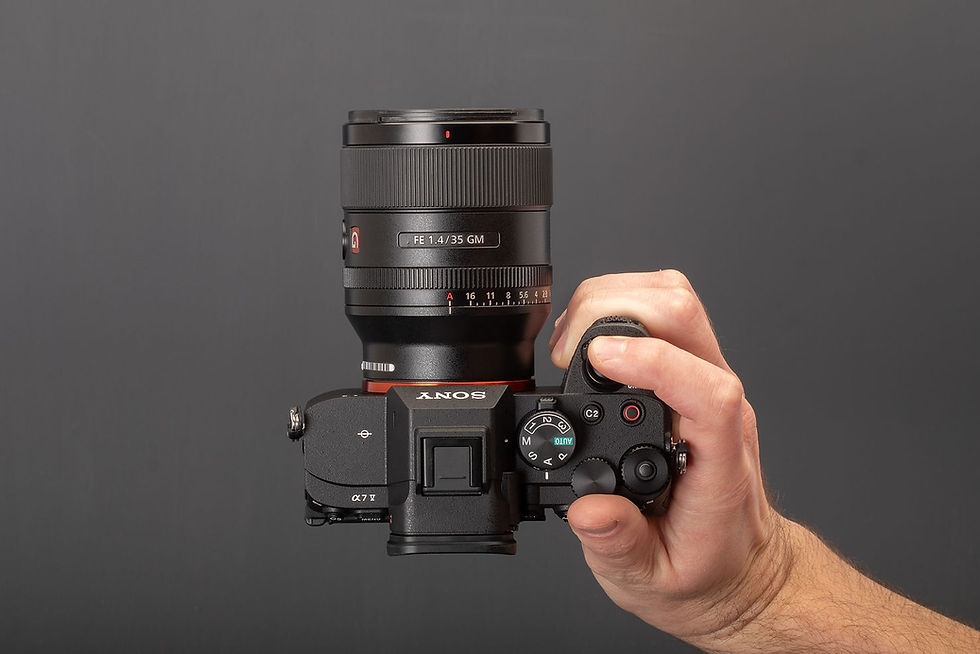
Battery Performance and Storage Options
Battery Life and Power Use: The A7 V uses the familiar NP-FZ100 battery, rated at approximately 2,280 mAh. Sony’s efficiency improvements raise CIPA endurance to around 750 frames using the rear screen and 630 frames using the electronic viewfinder, compared with roughly 580 LCD frames on the A7 IV. In practical use, photographers may exceed 1,000 frames when bursts are frequent and the camera spends less time displaying menus or reviewing images.
CIPA figures are designed for comparison rather than as exact production limits. Continuous burst shooting often produces far more frames per charge because the camera remains active for a shorter time per image, whereas long periods of menu use, image review, Wi-Fi transfer, high screen brightness and stabilised video can reduce endurance. Carrying at least one genuine or high-quality spare remains sensible for paid work.
For video, Sony quotes approximately 135 minutes of practical recording and a longer continuous figure under favourable conditions. The exact result depends on resolution, frame rate, stabilisation, temperature, screen brightness and wireless use. For events and long-form assignments, two or three batteries should cover a substantial working day. USB Power Delivery also allows the camera to record while receiving power from a compatible power bank or mains adapter.
The dual USB-C arrangement is particularly useful in fixed installations because one port can handle data or tethering while the other supplies power. As with every lithium-ion battery, capacity falls in very cold conditions, so spare batteries remain necessary for winter exteriors and remote locations.
Storage and Card Choices: One card slot accepts CFexpress Type A or SD UHS-II, while the other accepts SD UHS-II. CFexpress Type A offers read and write speeds above 800 MB/s but remains expensive and is available in fewer high-capacity options. V90 SD cards are less costly and more widely available, with practical write speeds around 250–300 MB/s.
Cold-weather performance follows the normal behaviour of lithium-ion batteries. Capacity and voltage fall as temperature drops, but warming a spare battery in an inner pocket can restore part of the available charge. In very low temperatures, rotating batteries and avoiding unnecessary screen use provides more reliable operation.
The camera’s highest common video data rate—approximately 600 Mb/s, or 75 MB/s, for 4K60 10-bit All-Intra—can be handled by a reliable V90 SD card. Continuous 30 fps stills create a more demanding workload because 33 MP RAW files can approach hundreds of megabytes per second. CFexpress therefore clears the buffer more quickly and extends the duration of maximum-speed bursts.
Fast SD cards are adequate for most projects, while CFexpress is most valuable for sustained action photography and rapid offloading. The two slots can be configured for simultaneous backup, separated RAW/JPEG recording or overflow. When recording to both cards at a high data rate, the slower card determines the practical limit.
Data Management: High-quality 4K60 All-Intra can consume approximately 5 GB per minute, so a 128 GB card may hold only around 25 minutes. For long professional sessions, 256 GB or larger cards are more practical. Long-GOP H.265 reduces storage use but places greater load on editing systems. Uncompressed RAW stills may be around 50 MB, while losslessly compressed files can be closer to 30 MB.
A realistic data plan should be prepared before the shoot. A full day of 4K All-Intra recording can generate hundreds of gigabytes, and two-card backup doubles the media requirement. The same data must then be copied to at least two independent storage locations before cards are formatted. Fast cards only solve capture speed; they do not replace a controlled backup and archive workflow.
At 30 fps, even compressed RAW production generates a very large data volume. High-speed cards, large backup storage and fast readers are therefore part of the real cost of using the camera at its maximum capability. Sony’s CFexpress Type A readers can transfer at several hundred megabytes per second over USB 3.2 Gen 2. Imaging Edge Desktop and applications such as Adobe Lightroom support the ARW files, and 10-bit HEIF is also available as an alternative to JPEG.

User Feedback and Professional Opinions
The A7 V received both strong praise and visible criticism immediately after launch. Professional reviews generally described it as an unusually capable hybrid camera, while some online communities reacted negatively to the absence of certain headline video features. Looking at both sides is important because the camera’s value depends heavily on whether the buyer prioritises fast stills, balanced hybrid use or specialised cinema functions.
Professional Reviews — Strengths: TechRadar argued that the camera becomes more impressive when examined beyond the specification sheet, highlighting the response speed and accuracy of the new sensor and processor. Image quality and noise control were considered strong for 33 MP. Reviewers also described the A7 V as competitive with the Canon EOS R6 Mark II and Panasonic S5 II, matching or exceeding them in several areas.
Amateur Photographer described the A7 V as an impressive all-rounder for enthusiast photographers and praised its dynamic range and composite high-resolution options. The exact maximum resolution quoted by different reports varies according to the selected composite or extended-RAW method, which is why buyers should distinguish between a single-frame sensor output and a software-generated high-resolution file.
B&H used the idea of a “Goldilocks” camera that performs strongly across many categories without becoming excessively specialised. PetaPixel highlighted AI autofocus and 30 fps shooting as flagship-derived technologies offered at a lower price. Video-focused reviewers drew attention to full-frame 7K-oversampled 4K60 and the ability to record for long periods without an active fan.
A recurring assessment was that the A7 V provides much of the practical experience of an A1-class body for significantly less money. The A1 Mark II still offers higher resolution and more extreme flagship capabilities, but many users do not need those final margins. Composite and extended-resolution RAW options, broad dynamic range and the 30 fps burst rate strengthen the A7 V’s value as an all-rounder.
Professional Reviews — Limitations: Criticism concentrated on video functions that some creators expected after a four-year product cycle. The absence of 3:2 open-gate recording, resolutions above 4K and RAW video output disappointed users comparing the camera with Panasonic models offering 5.9K or 6K open gate and internal ProRes. The 3.68-million-dot EVF was also regarded by some reviewers as dated beside 5.76- or 9.44-million-dot panels.
The price discussion is also influenced by the cost of the complete system. A body upgrade may require faster cards, additional storage, newer computers for H.265 editing and lenses capable of resolving 33 MP while tracking at 30 fps. For an existing Sony user with compatible batteries and FE lenses, the transition is easier; for a new system buyer, the total package should be compared rather than the body price alone.
Some professionals would prefer both slots to accept CFexpress Type A rather than only one. Others initially questioned the lack of a separate AI processor, although Sony says integrating AI into BIONZ XR2 improves efficiency without reducing performance, and autofocus tests support that claim. Price also rose from the A7 IV’s launch level, producing debate over whether the additional cost is justified despite the broader improvements.
Early User Feedback — Positive: Many A7 IV owners described the A7 V as a major upgrade, particularly in responsiveness and overall fluency. Wildlife and sport photographers were enthusiastic about 30 fps bursts and pre-capture. Low-light autofocus, AI white balance and Dynamic Active stabilisation also received positive comments. Some creators argued that the camera can replace separate vlog and stills bodies because it handles both roles convincingly.
Positive comments frequently focused on the camera’s speed rather than on one isolated specification. Faster startup, more responsive menus, blackout-free viewing, rapid subject recognition and improved screen operation combine to make the body feel more immediate in daily work. This cumulative improvement is why many A7 IV owners describe the upgrade as larger in practice than it first appears on a comparison table.
The absence of widespread overheating reports strengthened confidence in the revised thermal design. Owners recording handheld video praised the ability to walk and film without a gimbal in less demanding situations. The overall early-owner tone was that the long wait had produced a meaningful improvement rather than a minor revision.
Early User Feedback — Negative and Debated: A more hostile online response argued that Sony had not innovated enough. Cropped 4K120, no 8K, no open gate and no RAW output were repeatedly cited. Some discussions became polarised, with positive reviewers dismissed as brand loyalists. Industry reports nevertheless suggested strong pre-orders despite the criticism, indicating that the loudest online reaction may not represent the broader market.
A common counterargument was that the A7 V offers a very large proportion of an A1-class experience at roughly half the price, especially for photographers of fast subjects. Users focused on portrait and landscape work may feel the update differently, because those genres gain less from 30 fps and pre-capture. The value of the upgrade therefore depends on the work being produced rather than on a single headline specification.
Comparison with Competitors: The A7 V competes with cameras such as the Canon EOS R6 Mark II or III, Nikon Z6 III and Panasonic S-series bodies. Canon offers advantages including uncropped 4K60 and RAW output on certain models, while Sony provides 33 MP resolution, highly dependable autofocus and cropped 4K120. Nikon’s partially stacked Z6 III also targets high-speed hybrid use with a lower-resolution sensor.
Panasonic bodies may provide stronger cinema-oriented formats, including full-frame high-frame-rate and higher-resolution recording on some models. Sony retains a major advantage in subject-recognition consistency and autofocus confidence. Considered as a complete system rather than as a list of isolated features, the A7 V remains one of the most balanced cameras in its segment.
Conclusion: The Sony A7 V treats photography and video with equal seriousness. The A7 IV was already a strong camera but required compromises; the A7 V removes many of them. It retains 33 MP while greatly increasing readout speed, eliminates blackout during high-speed bursts, removes the full-frame 4K60 crop, adds 4K120, advances AI autofocus, improves battery endurance and introduces a better screen.
There are still specialised features it does not provide, including an internal ND filter, global shutter, 8K and open-gate recording. Those requirements belong to narrower production workflows or higher product tiers. For a much wider group of photographers and filmmakers, the A7 V is a mature hybrid body that combines resolution, speed and AI in a way that allows the operator to concentrate more directly on the subject and the production.
Sources:Sony’s official press material and technical documentation, early evaluations from specialist publications including PetaPixel and TechRadar, and user feedback collected through forums and interviews were used as the basis of the original review. Together, those sources show both the strengths and the genuine limitations of the A7 V. For users who need high photographic quality and flexible video performance in the same body, it is one of the most ambitious choices in its class.
Choosing the Right Camera for Professional Production
A powerful body such as the A7 V only reaches its real value when paired with the right lenses, lighting, sound and production plan. Do not plan around the camera alone; plan how your brand needs to appear on screen.
Related content: professional corporate-video production and Sony FX2 review.